In the realms of the global economy and international trade, the most influential force today is undoubtedly the intersection of environmental policy and trade regulations. As the European Union (EU) accelerates the full implementation of its flagship climate initiative—the Carbon Border Adjustment Mechanism (CBAM)—manufacturers and exporting nations worldwide are facing a dramatic shift in trade dynamics.
Often dubbed the "Carbon Border Tax," what exactly is this mechanism, why is it disrupting global commerce, and what lies ahead? Let's take a closer look.
1. What is the Carbon Border Adjustment Mechanism (CBAM)?

CBAM is an environmental trade policy designed to apply a carbon price on targeted goods imported into the EU, equivalent to the carbon cost born by domestic EU producers under the EU Emissions Trading System (ETS).
- Primary Objective: To prevent "carbon leakage"—a scenario where companies relocate production to countries with weaker environmental regulations to avoid costs—and to level the playing field for EU industries undergoing decarbonization.
- Core Covered Sectors: The measure initially targets carbon-intensive industrial sectors including steel, aluminum, cement, fertilizers, electricity, and hydrogen.
2. Why CBAM Has Become a Global Flashpoint
CBAM extends beyond climate governance; it is increasingly viewed as a new form of trade barrier and green protectionism.
- Rising Trade Tensions: Major exporters to the EU—including the U.S., China, India, and South Korea—have voiced concerns that CBAM acts as a tariff-like mechanism designed to shield European industries.
- Global Supply Chain Realignment: Exporters must now measure and report embedded direct and indirect carbon emissions throughout their entire production lifecycle. Failure to reduce emissions directly erodes product price competitiveness in the European market.
- Financial Burden via Carbon Certificates: Importers must purchase CBAM certificates corresponding to the carbon emissions generated during production, tying compliance costs directly to volatile carbon prices.
3. Key Outlook and Future Implications
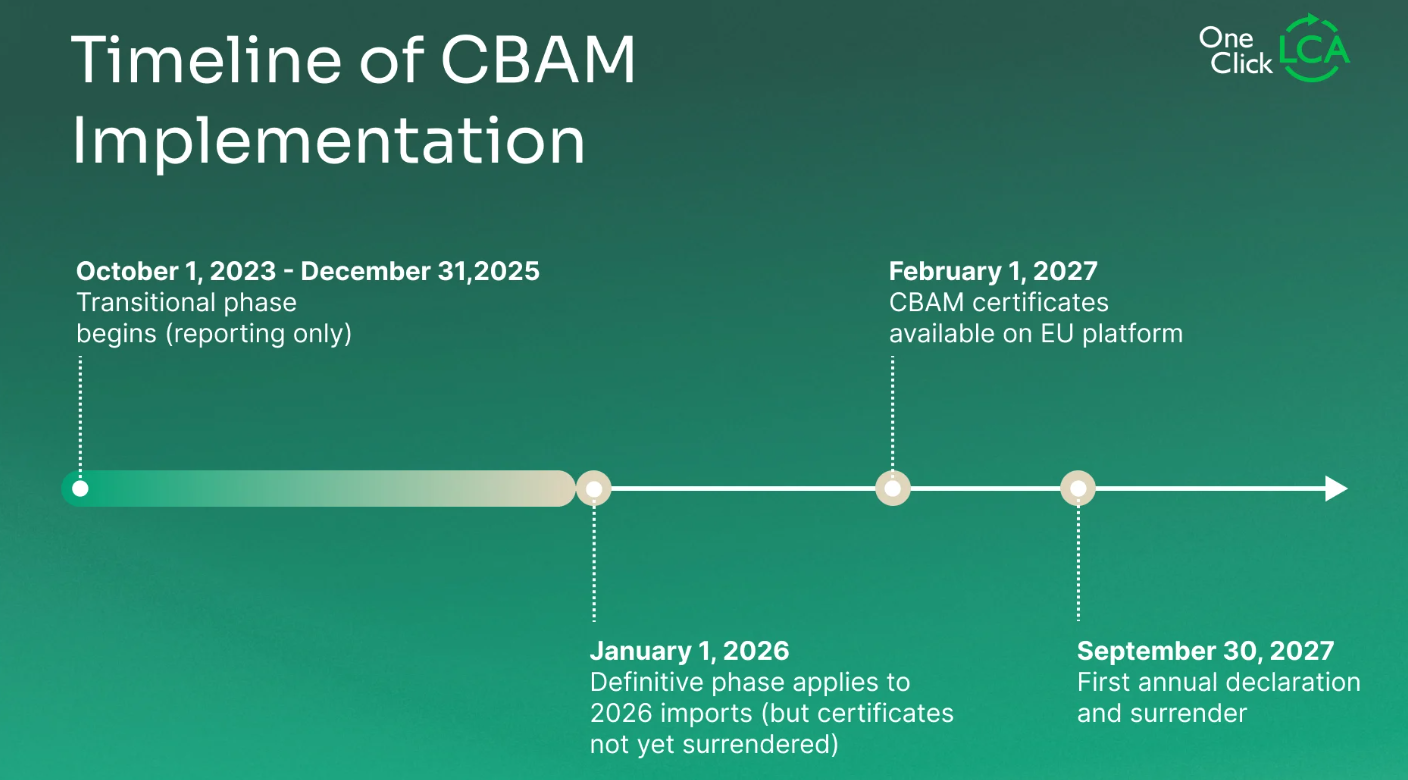
- WTO Compliance Debates: Tensions will likely persist over whether CBAM complies with World Trade Organization (WTO) principles, particularly non-discrimination rules.
- Domino Effect Among Major Economies: Similar legislative efforts, such as the U.S. Clean Competition Act (CCA), suggest that carbon intensity reporting is swiftly becoming a universal standard in global trade.
- Accelerated Corporate Transition to Renewable Energy (RE100): Transitioning to clean energy is no longer merely a corporate social responsibility initiative; it has become an imperative for survival in international commerce.
Conclusion
Under the banner of climate action, a fundamental restructuring of global trade rules is underway. The full operation of CBAM marks a crucial turning point that will redefine industrial competitiveness worldwide. Keeping a close eye on these shifts will be essential to understanding the direction of global economic policy.
'TODAY > 세계의 오늘' 카테고리의 다른 글
| 빅테크 비상! 'EU AI 법안' 전면 시행이 가져올 대격변 (0) | 2026.09.16 |
|---|---|
| 푸른 바다를 지킨 역사적 결단 — MARPOL 협약과 해양 환경 보호의 전환점 (9월 25일) (0) | 2026.09.16 |
| 193 Member States Assemble: Key Takeaways and Expected Bilateral Talks at UNGA 81 (0) | 2026.09.14 |
| 전 세계 193개국 집결! 제81차 유엔총회(UNGA 81) 개막과 주요 관전 포인트 (0) | 2026.09.14 |
| 시카고 대화재 (1978년 10월 8일) (4) | 2024.10.09 |